 DATAMARCOSTechnology LearningDATAMARCOSTechnology Learning
The Agentic Engineer is Datamarcos's Generative AI & Agentic AI Engineer programme: 18 weeks, live, where you build, evaluate and deploy real GenAI and agentic AI systems alongside a full-time job, mentored by Deepesh Mishra.
Trusted by teams at








30,000+ professionals trained across 200+ organisations. Logos are of organisations whose teams Deepesh has trained; they are not sponsors of this programme.
Read that again. Same companies. Same year. One group of people is being let go. Another group cannot be hired fast enough. The only difference is what they can build.
Every number above links to its source. Market data shows direction, not a promise of any job or salary for you.
You prompt ChatGPT. You watched the tutorials. You maybe built a demo. And you still could not put an AI system in front of a real user, on real data, and defend it. That is the gap companies are paying for.
Another course. Another notebook on clean sample data. Nothing you could defend in an interview or ship at work.
A chatbot demo takes an afternoon. Making it accurate on messy data, secure, measured and cheap to run is the actual job.
Teams are moving from chat to agents that use tools, call APIs and act inside Jira, Slack and databases. That is engineering, not prompting.
RAG systems, multi-agent copilots, production-hardened agents. Deployed, measured, defended.
Real feedback screenshots, learner videos and client teams further down this page. Check them.
About 10 hours a week. Two live sessions, one lab, project work. Recordings when work explodes.
Week-by-week roadmap, bridge pre-work, code reviews and a mentor who tells you what to fix.
No mystery curriculum. This is the path, built from the programme plan. Every phase ends with something you demo to a mentor panel.
What you do with it is yours. No job or salary is guaranteed.
Bridge pre-work: Python, Linux, Git and SQL refreshers so nobody starts behind.
How LLMs actually work. Prompt patterns that hold up in production.
Structured outputs and eval-first habits: measure before you ship.
Ship a tested FastAPI GenAI service. First demo.
Embeddings and vector databases.
Advanced retrieval, hybrid RAG over messy documents, secure text-to-SQL.
Evaluate it: RAGAS and DeepEval. Role-based access, PII masking, guardrails.
GraphRAG with Neo4j, multimodal documents. Panel review.
LangGraph: state, control flow, your first agent graph.
Tool use and MCP servers.
Multi-agent orchestration: CrewAI, OpenAI Agents SDK, Google ADK.
Memory and human-in-the-loop. Jira and ServiceNow integration.
Agent evals, cost and trace dashboard. Panel review.
OWASP LLM Top 10, guardrails, red-teaming.
LLMOps and tracing, cost engineering, model routing.
Cloud deployment with Docker, Terraform and CI/CD.
Security review, red-team report, runbooks, handoff. Panel review.
Build and harden your capstone. Mock interview loop 1. Resume and LinkedIn teardown.
Demo Day. Mock interview loop 2. Portfolio teardown. You defend it.
Topic order within a phase can shift slightly by cohort. Exact session days and times are confirmed on your call.

“… we learnt from anything from scratch so without you this much project can't be built.”
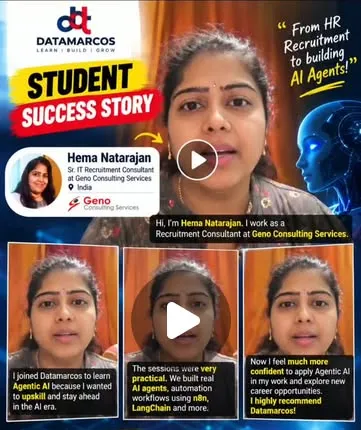
“The sessions were very practical. We built real AI agents and automation workflows using n8n, LangChain and more.”
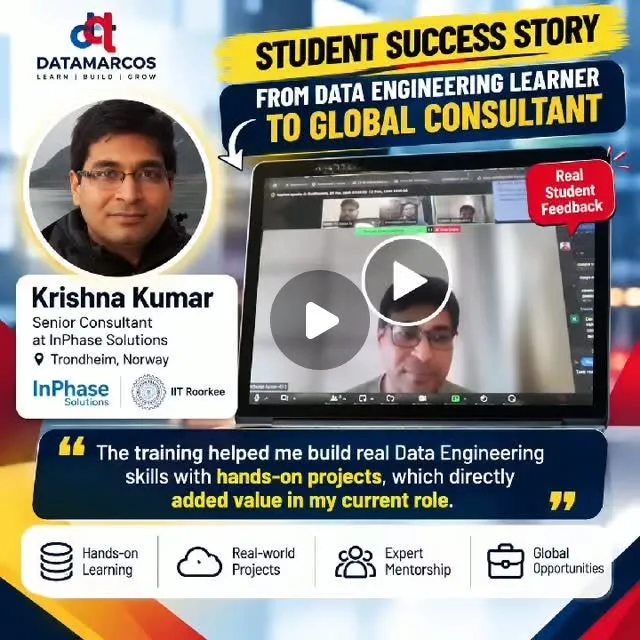
“The training helped me build real Data Engineering skills with hands-on projects, which directly added value in my current role.”
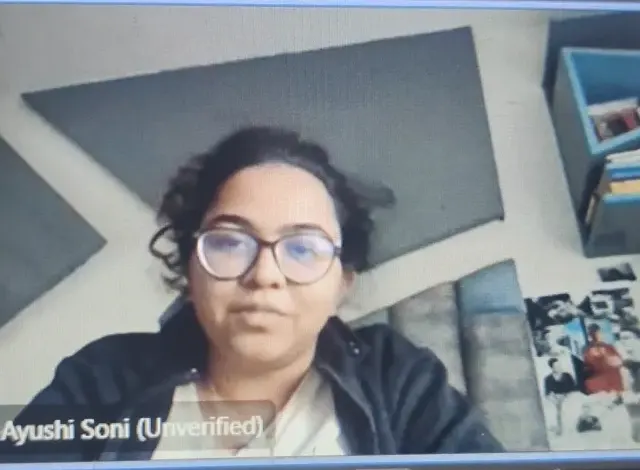
“… you made it pretty easy for Azure and explaining everything nicely so thank you so much for that.”
These learners studied Data Engineering or Agentic AI with Datamarcos, not this exact programme. Their videos and full quotes are below. Individual results vary.
You leave with a portfolio of working systems, not certificates.
Hybrid RAG over messy documents, secure text-to-SQL, role-based access, PII masking and guardrails, for a BFSI-style client.
A LangGraph supervisor with MCP tools, Jira and ServiceNow integration, human approval and a cost and trace dashboard.
Take the agent to production: security review, red-team report, compliance pack, UAT, runbooks and handoff.
Your domain, your problem. Discovery to deployment, defended at Demo Day in front of an industry-style panel.
Deepesh Kumar Mishra, founder and CEO of Datamarcos since February 2022, and an AI, ML and IoT consultant and corporate trainer since 2019. By his own LinkedIn count, more than 100 workshops and trainings delivered.
Mike Hamata, a learner in Datamarcos's live Applied Agentic AI Certification class, on what clicked for him: LLMs, prompt engineering, embeddings, vector databases, RAG, and how AI agents use tools and APIs to get work done.
“The way you taught us these concepts, especially Generative AI and Agentic AI, was actually very interesting … There's a big difference between just knowing about AI and actually understanding how to build something with it.”
Posted on @datamarcos_official on Instagram, 14 Nov 2026. The reel has background music; Mike's words are in the on-screen captions. Applied Agentic AI is a different Datamarcos programme.
… you made it pretty easy for Azure and explaining everything nicely so thank you so much for that.
… we learnt from anything from scratch so without you this much project can't be built.
The sessions were very practical. We built real AI agents and automation workflows using n8n, LangChain and more.
The training helped me build real Data Engineering skills with hands-on projects, which directly added value in my current role.
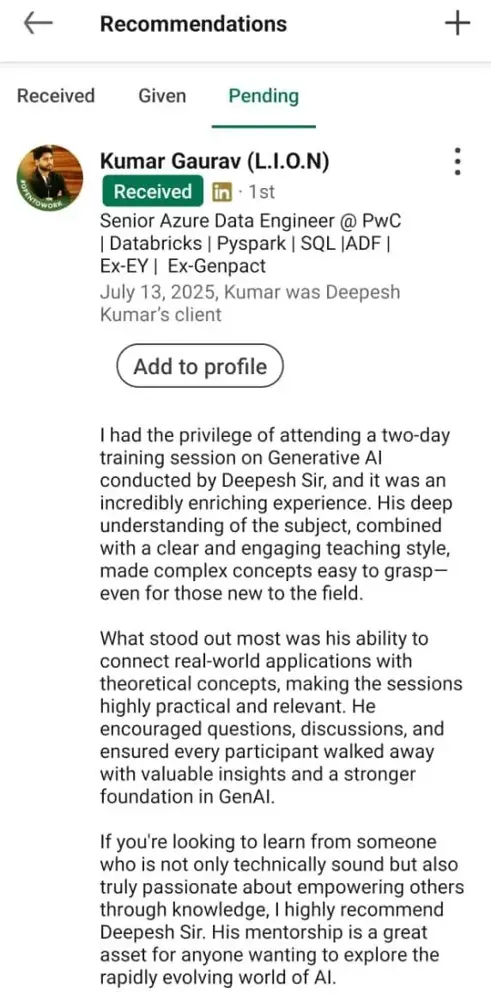
I had the privilege of attending a two-day training session on Generative AI conducted by Deepesh Sir … He encouraged questions, discussions, and ensured every participant walked away with valuable insights and a stronger foundation in GenAI.
As a complete beginner in Data Engineering, I was confused where to start … All my doubts were dispelled and I was able to hone my skills with great hands on activities and projects.
I had the opportunity to learn under Deepesh Mishra during my Data Engineering training, and I can confidently say he is one of the best trainers I've come across. His teaching style is clear, engaging, and highly effective.
What stood out most was his approach to training — he gave us the freedom to explore and emphasized practical learning through hands-on assignments and programming exercises. … Highly recommended for anyone who wants to learn deeply and practically!
 Lakshan S JLinkedIn recommendation · Training with Deepesh
… He not only did this just as a job he really wants his students to learn and grow. His grasp over the concepts of data Sciences is amazing.
It's a blessing to meet you and learn AI under your guidance. … Thank you so much
Deepesh possesses excellent communication skills and demonstrates in-depth expertise in both Generative AI and Data Engineering.
Quotes are verbatim, trimmed only where marked. Several learners above studied Data Engineering, Data Science or Applied Agentic AI, or attended corporate training with Deepesh, not this exact programme. Individual results vary.
Most people do not fail at AI because it is hard. They fail because nobody answers their questions, nobody reviews their work, and nothing forces them to ship. So we removed every one of those.
Solves: recorded courses that never answer your question.
Worth: a working architect in the room, twice a week.
Solves: code nobody checks, with bugs you do not know you have.
Worth: the feedback you would otherwise only get on the job.
Solves: an empty portfolio and “tell me about something you built”.
Worth: proof you can show, not a certificate you can print.
Solves: being stuck alone at 11 pm with nobody to ask.
Worth: weeks of wrong turns you never take.
Solves: “I'm not technical enough to keep up.”
Worth: you start Day 1 level with everyone else.
Solves: the week work explodes and you miss a session.
Worth: you fall behind by a day, not a month.
Solves: you can build it, but cannot explain it under pressure.
Worth: walking into interviews already rehearsed.
Solves: no proof you can defend a system in front of experts.
Worth: the hardest room you will face, faced before it counts.
If the programme is not right for you, ask within 7 days of your batch start or payment date, whichever is later, and you get a refund. You can find out for yourself with the risk on us.
We do not promise jobs or salaries. Anyone who does is selling something else. We give you the skills, four deployed projects and the interview practice. What you do with them is yours.
Live batches are kept small so every project gets a real review from a mentor. That is why there is an application, and why not everyone is offered a call. Next cohort starts 5 December 2026.
Fees and EMI options are discussed on the 1:1 call.
If you can write some Python, or you are strong in SQL with basic Python, you are technical enough. Bridge pre-work covers Python, Linux, Git and SQL before Day 1. If you have never written code at all, this is not the right starting point yet, and we will tell you that honestly.
Good, that is who it is built for. Plan for about 10 hours a week: two live sessions, a lab and project work. Sessions are recorded for the weeks work explodes. If you genuinely cannot find even 8 hours a week right now, wait for a later batch. That is not failure, it is timing.
Compare it to the real alternative: another year of tutorials and nothing deployed, while the market moves to people who can build. You leave with four deployed systems, interview practice and mentor reviews. The fee and EMI options are shared on the call, and the 7-day refund policy means you are not locked in. We still do not promise a job, and you should be wary of anyone who does.
Nobody can honestly promise what any job looks like in five years. What the data shows today: the companies cutting roles are also hiring people who can build, evaluate and deploy AI systems. TCS is planning up to 8,900 forward-deployed AI engineers; Microsoft had 870 open AI software engineer roles on the day it announced cuts. Building with AI is the work being added, not removed.
If you can write Python and are comfortable with SQL, yes.
Sessions are recorded and available in the student portal.
No. You get skills, a deployed portfolio and interview practice.
Cohorts are live and mentor-reviewed. One unprepared learner slows everyone down, so we check fit before the call.
Thirty minutes with Deepesh on a video call. Your background, your goal, whether this programme gets you there, and if not, what would.
Ten quick steps, about 5 minutes. There are no trick questions. Just answer honestly so Deepesh can prepare for your call.
A 30-minute video call. Bring your questions, and anyone else involved in the decision. Only open times from Deepesh's calendar are shown.
A Google Calendar invite has been sent to from deepesh.datamarcos@gmail.com. Accept it so the call stays on your calendar.
That is not a judgement on you. Starting a live, demanding programme at the wrong time usually costs more than waiting. When things change, apply again.